






The best magnifying glass depends on what you’re doing with it
There is no single best magnifying glass. The right one depends entirely on what you’re using it for — reading fine print needs a very different lens from inspecting jewelry or soldering electronics. A 10X loupe is the best magnifying glass for a jeweler and almost useless for someone with low vision trying to read a book. A lighted full-page magnifier is the best magnifying glass for reading and terrible for watch repair. This guide covers 12 picks across the main use cases, with honest notes on what each type is good at, what it’s bad at, the specs that actually matter when comparing two options, and which popular features are more marketing than function. The recommendations apply to both retail buyers choosing one magnifier for themselves and wholesale buyers sourcing across a product line.
How to actually pick the best magnifying glass for your needs
Before the 12 picks, three specs matter more than the brand or the price.
Magnification. Higher isn’t better. Higher power means a smaller field of view and a shorter working distance — a 30X loupe shows a tiny area and has to be held 8 mm from the object. For most everyday uses, 3X–5X is the sweet spot. Save 10X+ for precision work.
Light. A good lighted magnifier costs 30–60% more than an unlit version. It’s worth it for anyone reading indoors, inspecting fine detail, or working past sunset. If the budget allows only one choice, pick lighted.
Lens material. Optical glass gives the clearest image. Acrylic is lighter, shatterproof, and fine for kids’ products and carry-around use. Professional work (jewelry, electronics, pharma) should always be glass.
Everything else — frame material, handle style, battery type — is preference. These three specs determine whether the tool will actually get used.
The 12 best magnifying glasses by use case (2026)
1. Best magnifying glass for reading — a 3X lighted handheld
For reading books, newspapers, medication labels, and menus, a 3X handheld magnifier with built-in LEDs is the right pick for most people. The 3X power is strong enough to make small text comfortable without shrinking the field of view so much that you lose your place on the page. The LED light — usually 3 to 6 LEDs arranged around the rim — eliminates the shadow your hand casts and lets you read in any lighting condition.
Look for: optical glass lens (not acrylic), 75–90 mm lens diameter, USB-C rechargeable rather than disposable batteries, and a comfortable handle you can hold for 20+ minutes without strain.
Skip: 10X+ handhelds marketed as “reading magnifiers”. At 10X, the field of view is too small for comfortable reading.
2. Best magnifying glass for small print — a 5X lighted handheld with larger lens
If your main problem is very small print (medication inserts, legal contracts, footnotes), step up from 3X to 5X, and get a larger lens — 90–100 mm. The bigger diameter compensates for the smaller field of view at higher magnification. Make sure it’s lighted; at 5X you need good light to resolve fine detail.
Look for: 90–100 mm optical glass, adjustable LED brightness, a weighted handle that feels stable during long reading.
Skip: cheap plastic lenses — the edge distortion at 5X is severe and will give you a headache.
3. Best magnifying glass for low vision — a floor-standing magnifying lamp
People with macular degeneration, diabetic retinopathy, or other low-vision conditions benefit more from a stationary floor-standing magnifier lamp than any handheld. Floor-standing models put a 3X–5X lens on an adjustable arm with a large LED ring light, so you can sit in a chair and read comfortably without holding anything. The American Academy of Ophthalmology recognizes these as a primary low-vision reading aid.
Look for: daylight-spectrum LEDs (around 5000K), 3X power with a large 125 mm+ lens, a stable weighted base, and an arm long enough to reach your reading position.
Skip: under-$50 models — the lens quality is usually poor, and low-vision users especially need clear optics.
4. Best magnifying glass for jewelry — a 10X triplet loupe
For jewelry, gemstones, and hallmark inspection, the industry standard is a 10X loupe with a triplet lens — three optical elements cemented together to eliminate chromatic aberration and distortion. The 10X power is what the Gemological Institute of America uses for diamond grading. Below 10X you miss inclusions; above 10X the field of view and working distance get too small for practical use.
Look for: a triplet (not singlet or doublet) lens, metal frame (not plastic), folding design for pocket carry. For gemology add a UV light version to detect synthetic stones.
Skip: “20X jewelry loupes” — the magnification formula (M = 25 ÷ f) means a 20X loupe has a 1.25 cm focal length, which is impractical for extended inspection work.
5. Best magnifying glass for electronics and PCB work — a helping-hand station
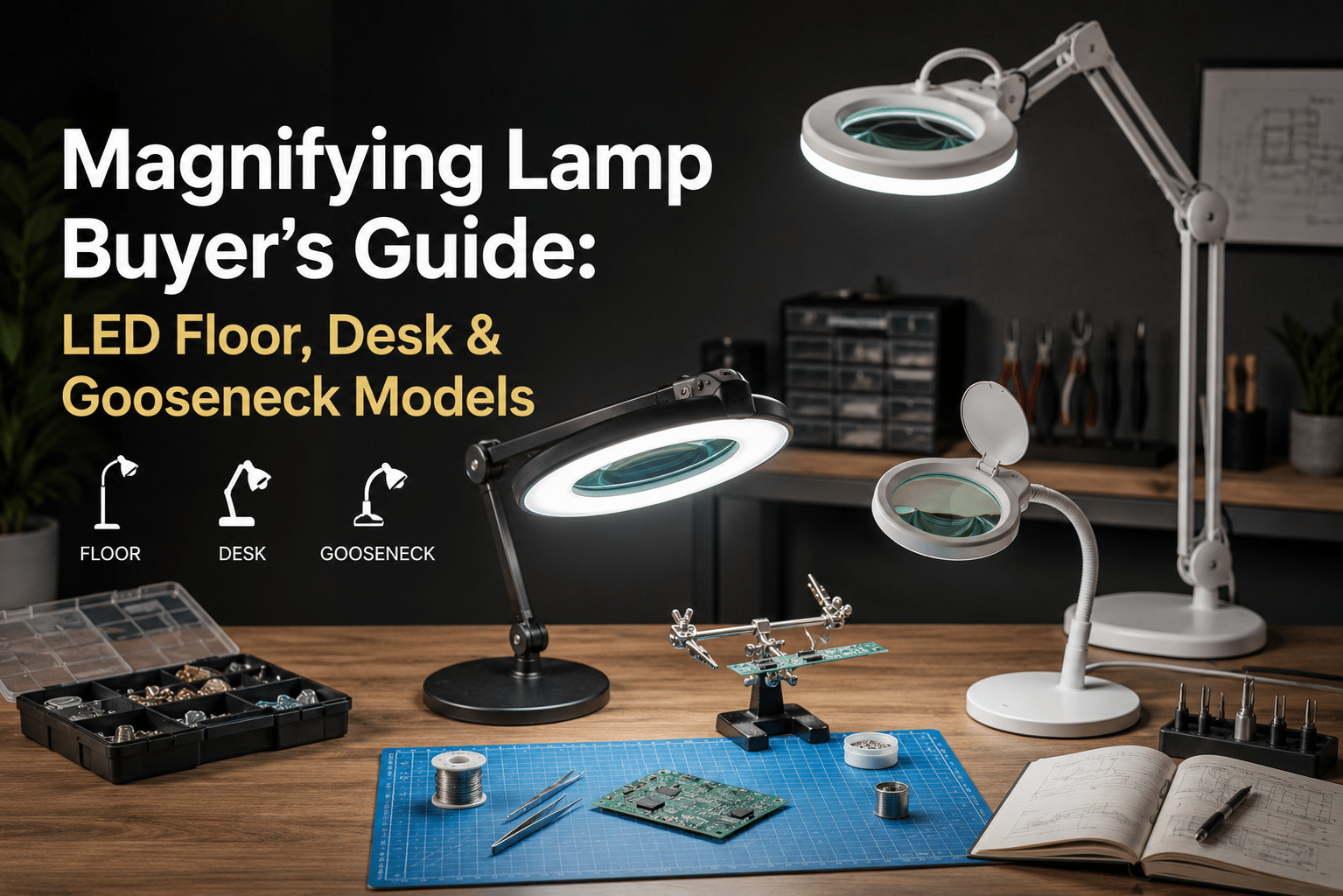
For soldering, PCB inspection, and electronics repair, a helping-hand station is the best magnifying glass because it frees both your hands. A good one has a weighted base, two articulating arms with alligator clips to hold the board, and a lit 3X–10X lens on a third arm. The lens is usually 90–100 mm so you can see a full component area, not just a single pin.
Look for: at least 1.5 kg base weight (lighter bases tip over), a lens at least 90 mm, adjustable LED brightness (bright is essential, but you’ll want to dim it for some work).
Skip: models where the lens is under 75 mm — too narrow for comfortable PCB work.
6. Best magnifying glass for crafts and hobbies — a hands-free stand lamp
For cross-stitch, needlework, model painting, and similar detailed hobbies, the best magnifying glass is actually a lamp. A hands-free stand-mounted lamp with a 2X–4X lens and a daylight LED ring lets you work for hours without eye strain. Floor-standing and clamp-mounted versions both work; pick based on where you sit to work.
Look for: daylight-spectrum LEDs, 2X–4X (higher magnifies your hands too much), large 125 mm+ lens, dimmable brightness.
Skip: chest-worn “hobby magnifiers” unless you specifically want to walk around while working. Most crafters find them uncomfortable for long sessions.
7. Best magnifying glass for coins and stamps — a dome magnifier
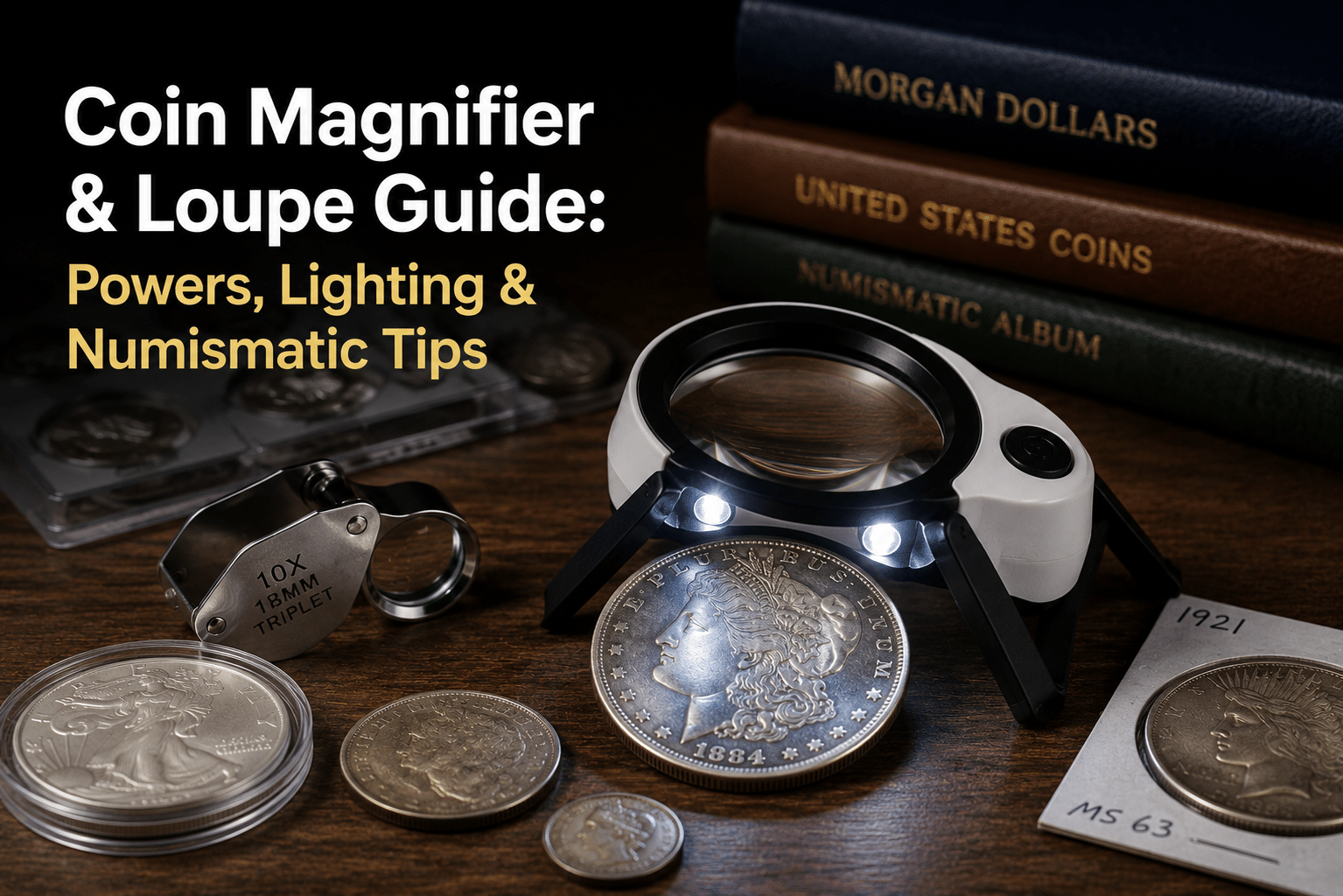
For flat objects like coins, stamps, and photos, a dome magnifier is surprisingly good. It’s a solid hemisphere of glass (or acrylic) that you place directly on the object. Because it’s in contact with the surface, it doesn’t need to be focused and always gives a sharp image. Typical power is 3X–5X, which is plenty for identifying mint marks, perforations, and condition.
Look for: solid optical glass (not plastic), 65–75 mm diameter, flat polished base that won’t scratch delicate surfaces.
Skip: cheap plastic domes — they scratch coins and stamps, which is worse than not having a magnifier at all.
8. Best magnifying glass for textile and fabric QC — a linen tester
Textile and garment manufacturers use a specialized tool called a linen tester — a folding metal-frame magnifier with a built-in measuring grid (usually 1 cm × 1 cm or 1 inch × 1 inch). You fold it open, set it directly on the fabric, and count threads per inch through the grid. Standard power is 10X.
Look for: metal frame (folds flat for storage and travel), built-in measuring grid, optional LED light for dark fabrics.
Skip: linen testers without the grid — without the grid, you’ve got a regular 10X loupe and are missing the point.
9. Best magnifying glass for kids and education — a 4X bug viewer
For children learning science, the best magnifying glass is a bug viewer — a small plastic dome with a 4X–10X lens on top and twin chambers below for observing live insects. Look for CE and EN71 certifications (European safety standards for children’s products), plus CPC if selling into the US market. The best models have two chambers, ventilation, and a release button so insects can be observed and set free.
Look for: CE + EN71 + CPC certifications, shatterproof acrylic lens, twin chambers with ventilation.
Skip: glass lenses (risk of breakage), anything uncertified (may not be safe for young children).
10. Best magnifying glass for travel and EDC — a folding pocket loupe
For travel, daily carry, and field inspection, a folding pocket loupe is the right tool. These are small — typically 15–25 mm diameter lens — but fold into a protective housing that clips to a keychain or fits in a pocket. Standard power is 10X; some double-lens models can flip up to 20X.
Look for: metal housing (plastic bodies break), glass lens (not acrylic at this size), keychain attachment point.
Skip: credit-card thin magnifiers if you need real power — they’re handy for reading but rarely more than 3X.
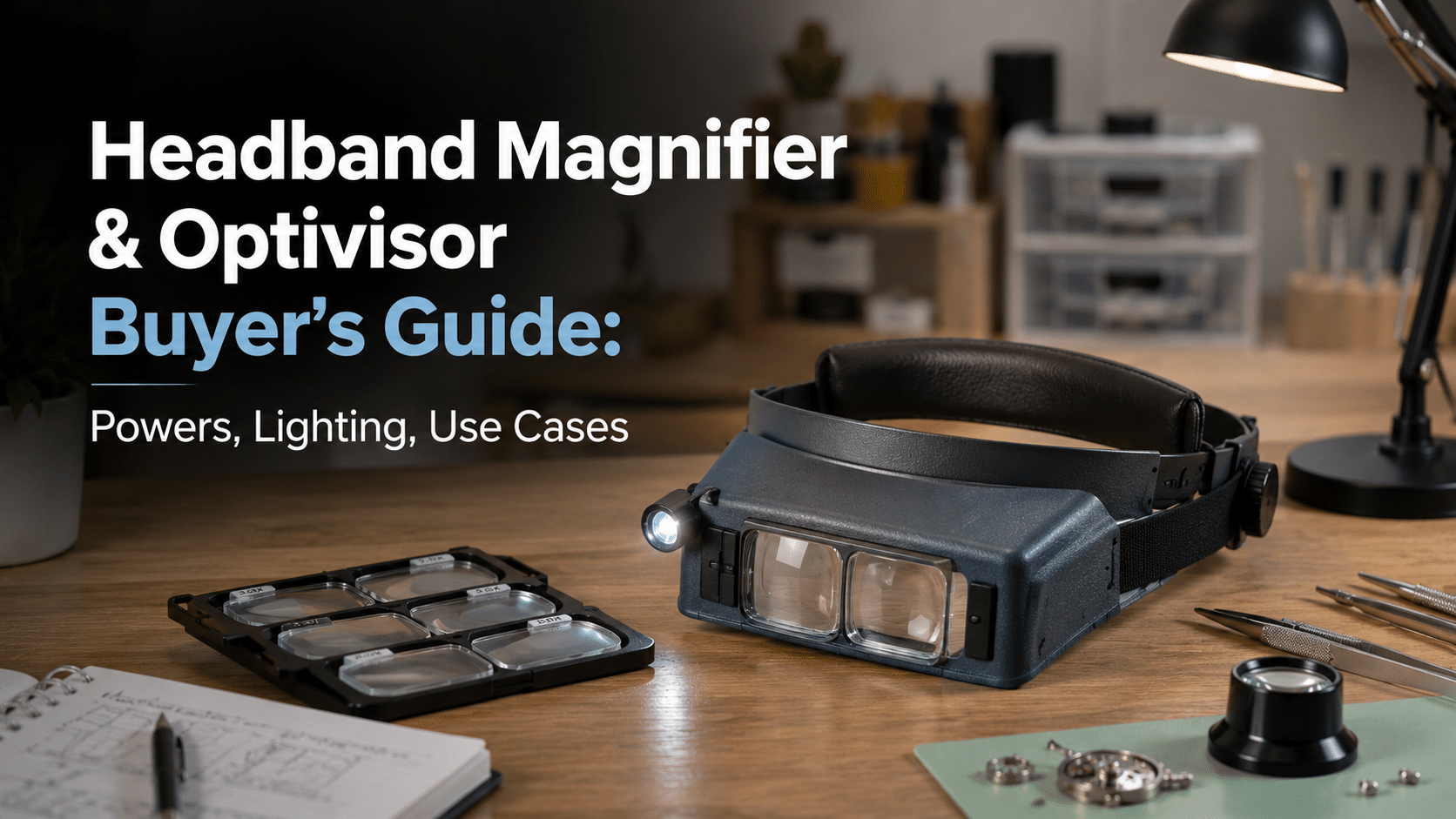
11. Best magnifying glass for watchmaking — a binocular headband magnifier
Watchmakers need both hands free and need to switch quickly between magnified and naked-eye views. A binocular headband magnifier (often called an OptiVISOR-style) does both. It has interchangeable lens plates in 2X–10X, a flip-up visor, and fits over regular eyeglasses.
Look for: interchangeable lens plates, flip-up visor, comfortable padded headband for long sessions.
Skip: single-eye loupes for this use case — they strain the dominant eye and cause fatigue during multi-hour repair work.
12. Best magnifying glass for wholesale and OEM sourcing — the full 2X–60X range
For wholesale buyers and OEM clients sourcing magnifiers for retail or industrial distribution, the right answer isn’t one product — it’s a supplier who covers the full range with consistent quality. That means 2X–10X handheld and lighted models for general retail, 10X–60X loupes and linen testers for jewelry and textile markets, magnifying lamps for craft and professional channels, helping-hand stations for electronics, and educational products with CE/EN71/CPC certifications.
Look for: a manufacturer with ISO 9001 certification, verifiable product specifications (focal length and field of view documented on spec sheets, not just X-power claims), flexible MOQ for testing new products, and OEM/ODM capability for private labeling.
Eleroyal manufactures across the full range. Browse handheld magnifiers, loupes and linen testers, or illuminated models, or request a wholesale quote with your product list.
At-a-glance comparison: 12 picks side by side
| Use case | Product type | Power | Key feature | Budget tier |
|---|---|---|---|---|
| Reading books, labels | Lighted handheld | 3X | LED + 75–90 mm glass lens | $30–60 |
| Small print, contracts | Lighted handheld | 5X | 90–100 mm glass + dimmable LED | $50–90 |
| Low vision daily reading | Floor-standing lamp | 3X–5X | Daylight LED ring, large lens | $150–400 |
| Jewelry and gemstones | Triplet loupe | 10X | Metal frame, three-element lens | $25–80 |
| Elektronica / PCB | Helping-hand station | 3X–10X | Weighted base, alligator clips, LED | $40–120 |
| Crafts and needlework | Stand-mounted lamp | 2X–4X | Hands-free, dimmable daylight LED | $80–250 |
| Coins and stamps | Dome magnifier | 3X–5X | Solid glass, no focusing needed | $15–40 |
| Textile / fabric QC | Linen tester | 10X | Folding metal frame + measuring grid | $15–50 |
| Kids and education | Bug viewer | 4X | CE/EN71/CPC certified, twin chambers | $8–25 |
| Travel and EDC | Folding pocket loupe | 10X | Metal housing, keychain | $15–40 |
| Watchmaking | Binocular headband | 2X–10X | Interchangeable plates, flip-up visor | $25–80 |
| Wholesale / OEM | Full range sourcing | 2X–60X | ISO 9001 supplier, flexible MOQ | Contact for quote |
A good magnifying glass for reading and a good magnifying glass for jewelry aren’t the same product — this table makes the tradeoffs visible at a glance.
What makes a magnifying glass “good”?
A good magnifying glass does three things well: it shows you clearly what you’re looking at, it doesn’t strain your eyes during extended use, and it holds up to daily handling.
Clear optics. Optical glass with proper grinding and polishing gives a sharp image edge-to-edge. Cheap acrylic distorts at the lens edges, which is where most of your peripheral vision lives. If you find yourself tilting the magnifier to center the text, the lens is too distorted.
Appropriate power for the task. The best magnifying glass for you is the lowest power that lets you see what you need to see. Higher power compresses field of view and working distance. Match the power to the task, not to marketing claims.
Solid construction. Frames crack, handles break, hinges fail. Metal frames last decades; cheap plastic frames last a season. For daily-use tools, pay for metal.
Good light (when needed). For anything indoor or detail-focused, built-in LEDs transform a good magnifier into a great one. Rechargeable is better than disposable batteries for frequency of use and environmental cost.
Magnifying glasses to avoid
Not every magnifier on the market is worth buying. Common red flags:
“20X handheld magnifiers” marketed for reading. The magnification formula (M = 25 ÷ f) means a 20X lens has a 1.25 cm focal length. That’s a working distance shorter than your nose. These products exist because “20X” sounds powerful on a listing, not because they’re usable.
Unbranded cheap lighted magnifiers under $10. The LED quality is usually poor (flicker, color cast), the lens is acrylic and distorts at the edges, and the battery compartment corrodes within months. Spend $20+ for something that’ll last.
Plastic jewelers loupes marketed as “10X triplet”. Real triplet lenses are three separate optical elements cemented together. A plastic injection-molded single lens isn’t a triplet no matter what the listing says.
“Lighted” magnifying sheets with printed LED icons. Some Amazon listings for Fresnel magnifying sheets show LED graphics in the product photos that don’t exist in the actual product. Read reviews carefully.
Magnifiers without certification for kids’ products. If a children’s magnifier doesn’t carry CE, EN71 (EU), or CPC (US) certification, don’t buy it. These certifications exist because kids put things in their mouths and drop them on hard surfaces.
Sourcing the best magnifying glasses wholesale
If you’re a wholesaler, retailer, or importer sourcing magnifying glasses, Eleroyal manufactures every category covered in this guide — handheld, lighted, hands-free, loupes, linen testers, magnifying lamps, helping-hand stations, educational, and pocket. We supply wholesalers and OEM clients in 30+ countries with flexible MOQ, full certifications (CE, RoHS, ISO 9001, EN71, CPC), 24-hour response, and a 12-month warranty with replacement on defective units.
For custom OEM orders, we provide third-party lens verification testing, full documentation, and private labeling. Learn more about the ISO 9001 quality management standard we work to.
What is the best magnifying glass for reading?
For most people, a 3X lighted handheld magnifier with a 75–90 mm optical glass lens is the best magnifying glass for reading. The 3X power is strong enough for books, newspapers, and medication labels without shrinking the field of view. A built-in LED eliminates hand shadows and lets you read in any lighting. For very small print or low vision, step up to 5X with a larger lens.
What’s the best magnifying glass for reading small print?
For very small print — medication inserts, legal contracts, footnotes — a 5X lighted handheld with a 90–100 mm lens works best. The larger diameter compensates for the smaller field of view at higher magnification, and the built-in light resolves fine detail that 3X with a smaller lens might miss. Avoid cheap acrylic lenses at this power — edge distortion becomes noticeable.
What is a good magnifying glass for hobbies?
For most hobbies (model building, needlework, electronics, jewelry making) the best magnifying glass is a hands-free stand-mounted lamp with a 2X–4X lens and a daylight LED ring. Hands-free is the key feature — holding a magnifier while doing detailed work causes fatigue within minutes. Floor-standing or clamp-mounted versions both work; pick based on your work setup.
Are expensive magnifying glasses worth it?
For occasional casual use, no — a $20 handheld is fine for reading labels. For daily use, yes — a $60–100 magnifier with optical glass, USB-C rechargeable LEDs, and a metal frame will outlast and outperform three or four cheap ones. Professional users (jewelers, electronics technicians, low-vision readers) should skip the budget tier entirely.
What’s the difference between a magnifying glass and a loupe?
A loupe is a small, high-power magnifier (typically 10X and up) designed for close inspection of small objects — jewelry, gems, watches, stamps. A magnifying glass is the broader term and usually refers to handheld models in the 2X–10X range used for reading and general inspection. Loupes are optimized for detail; magnifying glasses are optimized for field of view.
What magnification is best for general use?
For general everyday use — reading labels, examining receipts, inspecting small objects around the house — 3X to 5X is the sweet spot. Below 2X you won’t notice much enlargement; above 5X you’ll lose too much field of view for casual use. Anything higher than 10X is specialty equipment.
Do I need a magnifying glass with light?
For indoor use, fine detail work, or any use past sunset — yes, a lighted magnifying glass is much more useful. The LED eliminates the shadow your hand casts and lets you read in dim kitchens, bedrooms, and restaurants. For outdoor daytime use or pure hobby collecting, unlit works fine. Most wholesale buyers find lighted models sell at higher margins.