






A magnifying glass is used for reading small text, inspecting close-up details, and examining objects the naked eye can’t see clearly. The most common uses are reading medication labels and fine print, inspecting jewelry and gemstones, checking solder joints in electronics, examining insects and plant specimens, and helping people with low vision read comfortably. Most handheld magnifying glasses range from 2X to 10X magnification — enough for everyday tasks but not as powerful as a microscope. Higher-powered versions called loupes go up to 60X and are used by jewelers, gemologists, and quality-control inspectors in manufacturing. Modern magnifying glasses come in handheld, hands-free, lighted, and wearable forms to suit different tasks. Eleroyal has manufactured optical magnifiers in Ningbo, China since 2008, supplying wholesalers and OEM clients across 30+ countries with CE, RoHS, and ISO 9001-certified products.
Quick answer: what to know in 30 seconds
- Everyday use: reading small text, inspecting close-up details
- Typical power: 2X to 10X for general use, 10X to 60X for jewelry and precision work
- Main form factors: handheld, lighted, hands-free, loupes, magnifying lamps
- Lens material: optical glass (clearest) or acrylic (shatterproof and lighter)
- No power needed for basic models; lit versions use rechargeable batteries or AA cells
How does a magnifying glass work?
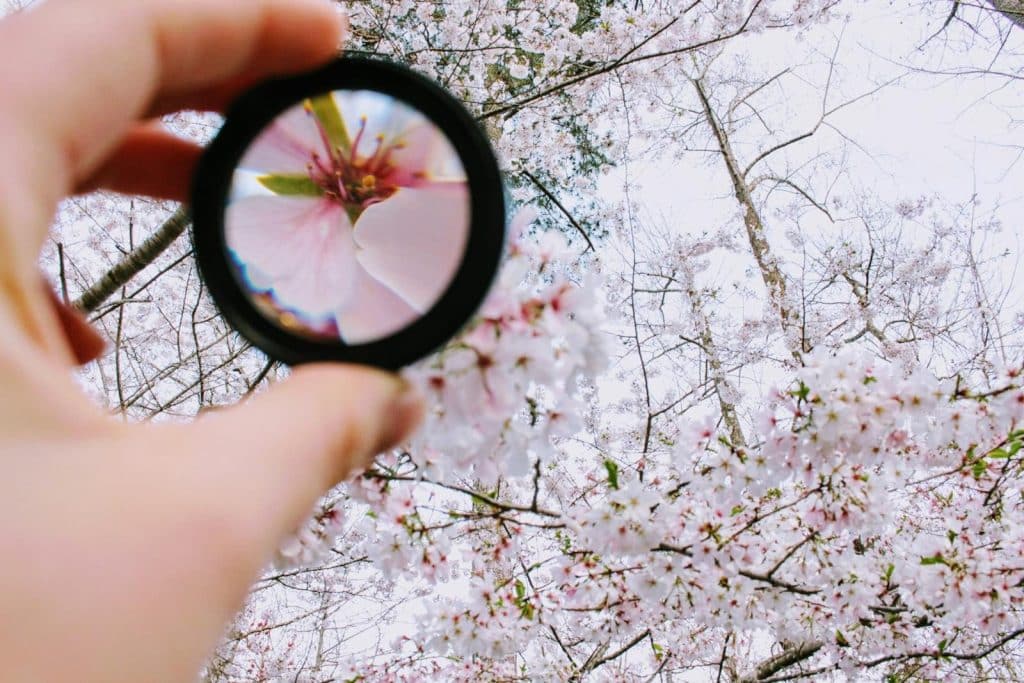
A magnifying glass works by bending light through a curved lens. The lens is convex — meaning it bulges outward — which causes light rays from an object to converge as they pass through it. When you hold the glass close to something small, the lens creates an enlarged image that your eye perceives as bigger than the actual object.
Three things control how much a lens magnifies:
The curve of the lens. A more steeply curved lens bends light more sharply and produces higher magnification, but it has to be held closer to the object.
The focal length. This is the distance at which the lens forms its sharpest image. Shorter focal lengths give higher magnification; longer focal lengths give lower magnification but a wider view of the page or object.
The lens material. Optical glass gives the clearest image with minimal distortion. Acrylic is lighter and won’t shatter, which is why it’s used in kids’ products and promotional items, but higher-end tools use glass for clarity.
That’s why a small jewelers loupe can show you fine detail in a diamond but only over a tiny area, while a large full-page reader covers an entire paragraph at lower magnification. Higher power always means a smaller field of view and a shorter working distance. You can’t have both.
What does “magnification” actually mean?
Magnification is how many times bigger something looks through the lens compared to how it looks to the naked eye. A 5X magnifier makes things look five times larger. A 10X loupe makes them look ten times larger.
You’ll also see magnifiers rated in diopters, especially for magnifying lamps and low-vision aids. Diopters measure the lens’s optical power, and the conversion to X-power is:
X-power ≈ (Diopters ÷ 4) + 1
So a 4-diopter lamp is about 2X, and a 20-diopter craft magnifier is about 6X. The two scales aren’t interchangeable in marketing copy — a “5-diopter” magnifier and a “5X” magnifier are very different products. If you’re buying wholesale, always confirm which scale a supplier is using.
15 everyday uses for a magnifying glass
Here are the most common uses for a magnifying glass, grouped roughly by category.
Reading and daily life
1. Reading fine print on medication labels and food packaging. This is the most common use, especially for older adults and anyone with reduced near vision. A 2X–4X handheld works well; a lighted version helps in dim kitchens and bedrooms.
2. Reading books, newspapers, and screens with low vision. Full-page magnifying sheets, floor-standing magnifying lamps, and lighted handhelds are used by people with macular degeneration and other low-vision conditions. The American Academy of Ophthalmology recognizes these as primary assistive reading devices.
3. Examining fine print in legal documents and contracts. Legal professionals and notaries use flat bar magnifiers that sit on the page and enlarge one line at a time — useful for reviewing dense contract text without losing your place.
4. Reading sheet music during practice or performance. Musicians use clamp-mounted or floor-standing magnifying lamps to enlarge small notation. Common in piano studios and orchestra pits.
Jewelry, watches, and collectibles
5. Inspecting jewelry, gemstones, and hallmarks. Jewelry appraisers, gemologists, and watchmakers use 10X loupes as the industry standard — the Gemological Institute of America uses a 10X loupe for diamond grading. Higher-power 30X–60X models with built-in UV light are used to detect synthetic stones and check for inclusions.
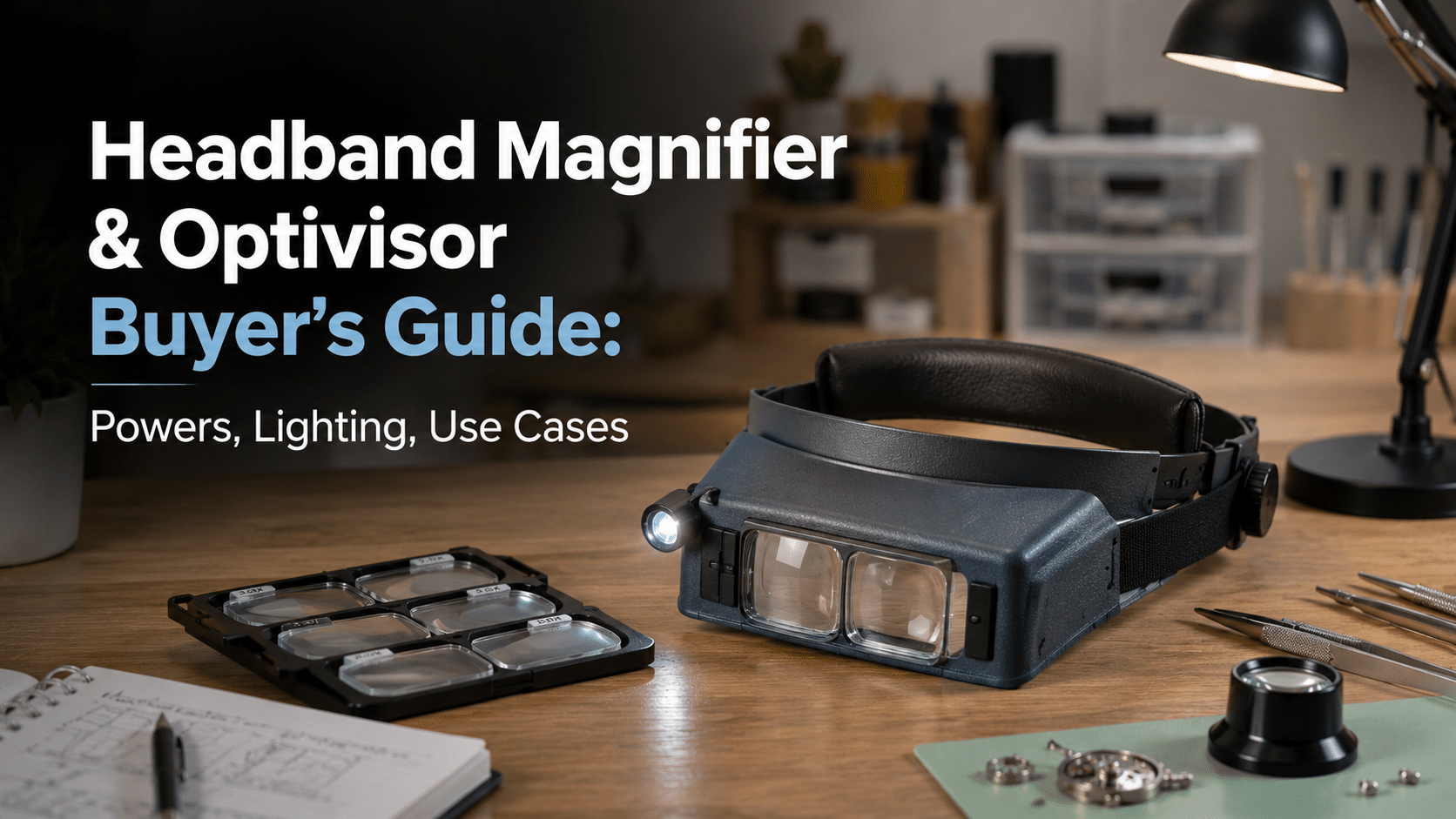
6. Watch and clock repair. Watchmakers use single-eye loupes (5X–20X) or binocular headband magnifiers to take apart and service movements. Headband models let you flip the lenses up for naked-eye work between close-up tasks.
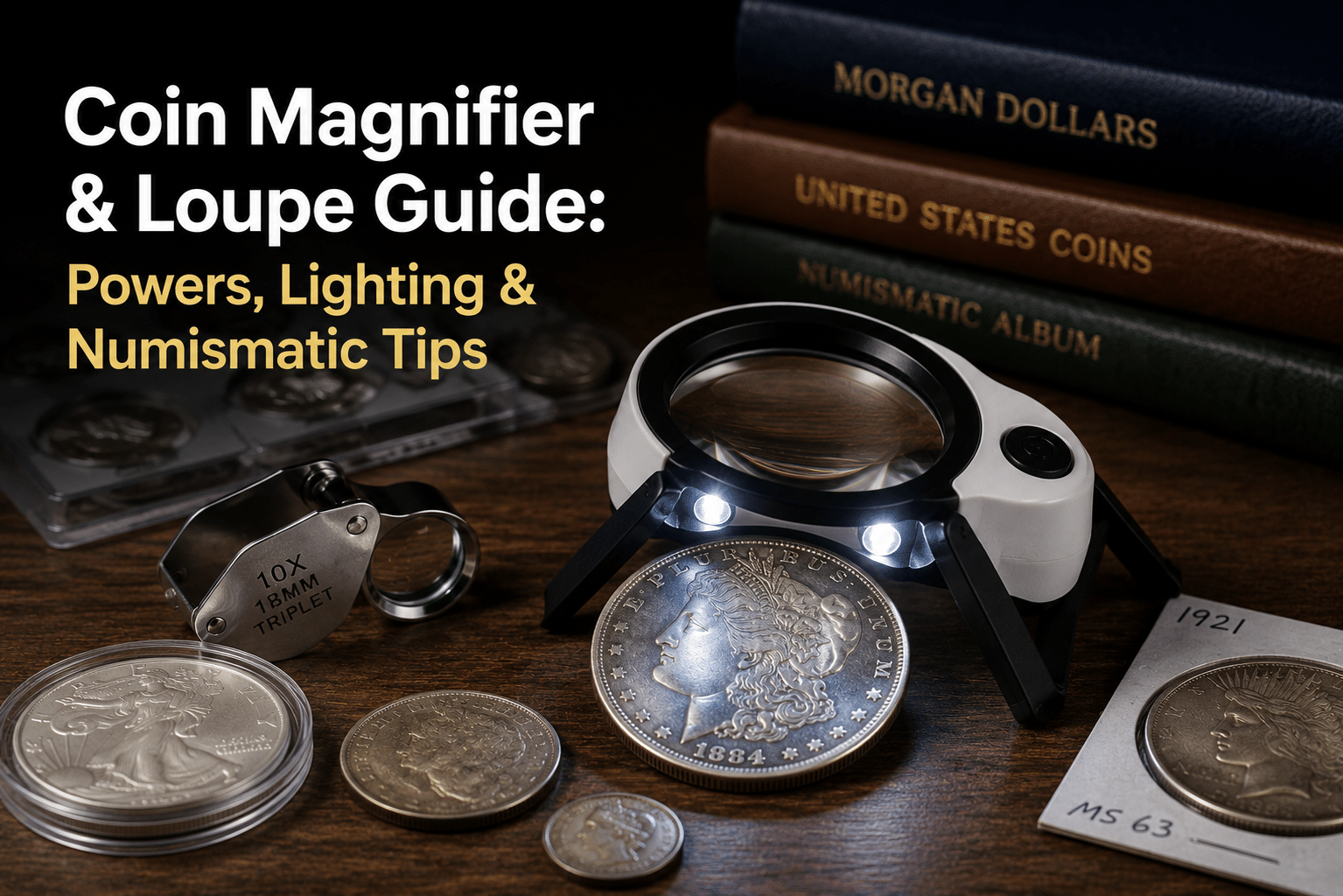
7. Coin and stamp collecting. Collectors use 5X–20X loupes to inspect mint marks, stamp perforations, and ink quality. Dome magnifiers — flat-bottomed hemispheres that sit directly on the surface — are especially useful because they don’t need to be focused.
Professional inspection and QC
8. Checking solder joints and PCB components in electronics. Electronics technicians use 10X–30X magnifiers, often with built-in LED lighting and alligator-clip stands, to inspect solder joints and surface-mount components. This is one of the biggest uses in industrial quality control.
9. Inspecting textile thread density and weave quality. Fabric QC inspectors use linen testers — folding 10X–30X magnifiers with a built-in measuring grid — to count threads per inch and identify weave defects. The tester folds flat and sits directly on the fabric.
10. Pharmaceutical inspection and pill identification. Pharmacists use lighted 5X–10X magnifiers to read pill imprints and verify dosages. Many come with UV light for tablet surface inspection.
11. Verifying currency authenticity. Bank tellers, cashiers, and currency collectors use 10X–40X magnifiers with UV light to check watermarks, security threads, and microprinting on banknotes.
Hobbies and crafts
12. Soldering, model-building, and small repairs. Helping-hand stations — weighted bases with adjustable arms, alligator clips, and a lit 3X–25X lens — let you work with both hands free. Used for electronics repair, model kits, and jewelry assembly.
13. Cross-stitching, needlepoint, and beading. Crafters use hands-free stand-mounted or chest-worn magnifying lamps in the 2X–4X range. Daylight-spectrum LEDs reduce eye strain during long sessions.
Education and nature study
14. Identifying insects, leaves, and plant specimens. Entomologists, botanists, and curious kids use 4X–10X handhelds and bug viewers to examine specimens. Kids’ bug viewers usually have twin chambers with ventilation so insects can be observed and released.
15. Science experiments and STEM learning. Schools and home educators use kids’ magnifying glasses, bug viewers, and Montessori nature observation tools for early science education. Anything sold for children needs CE, EN71, and CPC safety certifications.
Which magnification should you pick?
The right power depends on what you’re looking at. Higher isn’t always better — higher magnification means a smaller working area and a shorter distance between the lens and the object.
| What you’re doing | Recommended power | Best format | Typical lens size |
|---|---|---|---|
| Reading books and newspapers | 2X–3X | Full-page sheet or handheld | 90mm–A4 |
| Reading labels and fine print | 3X–5X | Handheld, lighted handheld | 75–100mm |
| General hobbies and inspection | 5X–10X | Lighted handheld, helping hand | 50–75mm |
| Jewelry, gemstones, electronics | 10X–30X | Jewelers loupe, linen tester | 18–30mm |
| Gemstone grading, micro-components | 30X–60X | High-power loupe with UV | 15–25mm |
A quick rule: if you need to use a tool while looking at the object (soldering, repair work), you want lower magnification and a longer working distance. If you just need to see detail clearly without manipulating the object (jewelry inspection, gem grading), higher magnification is fine.
Types of magnifying glasses
Most magnifying glasses fall into one of nine categories, each suited to different jobs.
Handheld magnifiers. A rigid frame with a handle, typically 2X–10X. The everyday kind most people picture. Lighted versions cost more but are much more useful in dim environments.
Lighted (illuminated) magnifiers. Built-in LED lights eliminate shadows and reduce eye strain. Available as handhelds, stand-mounted, and rechargeable pocket models. Browse the illuminated magnifier catalog for the full range.
Loupes and linen testers. Small, high-power (10X–60X) magnifiers for jewelry, gemstones, watches, and textiles. Includes folding pocket loupes, UV-equipped models for gemstone authentication, and metal-frame linen testers with measuring grids. See the loupe and linen tester range.
Hands-free magnifiers. Stand-mounted, neck-worn, or clamp-on models that free both hands. Used for crafts, electronics work, and long reading sessions.
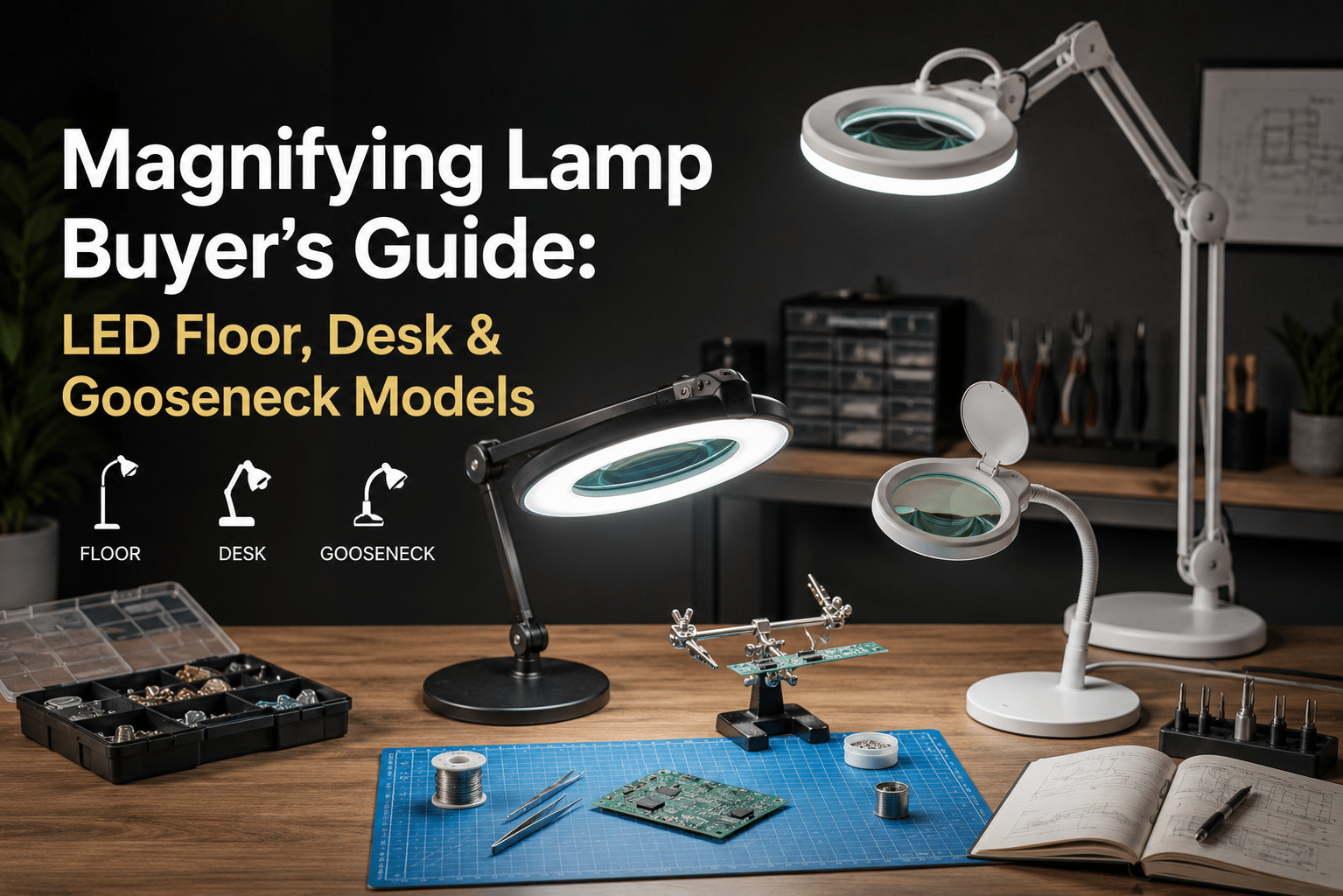
Magnifying lamps. Desktop, clamp, or floor-standing lamps with a 2X–5X lens ringed by LEDs. The standard tool for tattoo studios, dental hygiene, esthetics, and detailed crafting.
Helping hand magnifiers. Heavy base, two articulating arms with alligator clips, and a lit 3X–25X lens. Used for soldering and small assembly work.
Magnifying sheets and bookmarks. Flat Fresnel lens sheets in A4, half-page, credit-card, and bookmark sizes. Lightweight, inexpensive, and popular for promotional and bulk orders.
Educational and kids’ magnifiers. Kid-safe magnifiers, bug viewers, and STEM kits with CE, EN71, and CPC certifications.
Pocket and portable magnifiers. Folding, slide-out, keychain, and credit-card sizes designed to carry around. Common in promotional and gift markets.
Magnifying glass vs. microscope vs. magnifying lamp
These three tools get confused often, so here’s a quick comparison.
| Tool | Power range | Working distance | Best for | Needs power? |
|---|---|---|---|---|
| Magnifying glass | 2X–60X | A few mm to arm’s length | Reading, inspection, jewelry, hobbies | No (or LED) |
| Microscope | 40X–1,000X+ | Under 10mm, mounted | Lab work, cell biology, metallurgy | Yes |
| Magnifying lamp | 2X–5X | 30–60 cm | Crafts, tattoos, low-vision reading | Yes (mains) |
A magnifying glass is the most versatile of the three — portable, instant, and useful for a wide range of tasks. A microscope is for lab-grade work on prepared specimens. A magnifying lamp is essentially a stationary lighted magnifier for long hands-free sessions.
How to choose a magnifying glass: five things that matter
1. Power. Match the magnification to the job using the chart above. For most general uses, 3X–5X is right.
2. Lens material. Optical glass gives the clearest image and is preferred for professional work. Acrylic is lighter and shatterproof — better for kids’ products and carry-around use.
3. Lens size. Bigger lenses cover more area but at lower magnification. A 90mm lens at 3X shows a full paragraph; a 25mm lens at 30X shows a single character.
4. Lighting. Lit models cost 30–60% more but are essential for low-light reading, low-vision users, electronics, and jewelry work. USB-C rechargeable is the current premium standard; AA battery is the budget standard.
5. Certifications. For Europe, you need CE and RoHS. For kids’ products in Europe, you also need EN71; for the US children’s market, CPC. ISO 9001 at the manufacturer level is increasingly required by larger retail chains. Eleroyal carries all five across its product line — see the ISO 9001 quality management standard for full requirements.
Common mistakes people make when buying a magnifying glass
Most complaints about magnifying glasses come down to a few avoidable mistakes.
Buying higher magnification than you need. Most people overestimate. A 30X loupe sounds powerful, but at 30X the working distance is about 2 cm and the field of view is a few millimeters — nearly useless for reading or hobby work. For everyday reading, 3X is usually right. For hobby and inspection, 5X–10X is the sweet spot.
Assuming bigger lens means better. A larger lens covers more area, but larger lenses are almost always lower magnification — physics forces the tradeoff. Pick the lens size after you’ve picked the magnification, not before.
Ignoring the lens material. A cheap acrylic lens can look fine until you try to read small text through the edges — distortion at the rim is severe. If clarity matters, pay for optical glass. If the product is for kids or promotional use, acrylic is the right choice because it’s lighter and won’t shatter.
Skipping lighting. Unlit magnifiers save money but are much harder to use in kitchens, bedrooms, and other everyday environments. For most buyers, a lighted model is worth the extra cost.
Mixing up X-power and diopters. A “4-diopter” magnifying lamp is not the same as a “4X” magnifier — it’s about 2X. Always check which scale the supplier uses before comparing two products or placing a wholesale order.
Sourcing magnifying glasses wholesale
If you’re sourcing magnifying glasses for wholesale, retail, or OEM, Eleroyal manufactures the full range described in this guide — handheld, lighted, hands-free, loupes, linen testers, magnifying lamps, sheets, helping-hand stations, and educational models. We supply wholesalers, importers, and OEM clients in 30+ countries with flexible MOQ, full certifications (CE, RoHS, ISO 9001, EN71, CPC), 24-hour response, and a 12-month warranty with replacement on defective units.
What is a magnifying glass used for in everyday life?
It’s mainly used for reading small text and inspecting close-up details. Everyday uses include reading medication labels and food ingredients, examining jewelry and gemstones, checking solder joints in electronics repair, identifying insects and plant specimens, and helping people with low vision read comfortably. Lighted versions extend these uses into dim environments.
How does a magnifying glass actually work?
It works by bending light through a convex lens. The lens bulges outward, which causes light rays passing through it to converge. When you hold the lens close to an object, your eye perceives the light as coming from a larger version of the object than actually exists. The amount of magnification depends on how steeply the lens is curved and its focal length.
What’s the difference between X-power and diopters?
X-power tells you directly how much bigger things look — a 5X lens makes things look five times larger. Diopters measure the lens’s optical strength and are common on reading lamps and low-vision aids. To convert, use: X-power ≈ (Diopters ÷ 4) + 1. So a 4-diopter lamp is about 2X.
What magnification do I need for jewelry work?
10X is the industry standard for diamond and gemstone grading — it’s the magnification used by the Gemological Institute of America. For deeper inspection and synthetic stone detection, 30X–60X loupes with UV light are used. Higher power means a shorter working distance, which is why 10X remains the standard balance of detail and usability.
Do I need a lighted magnifier or a regular one?
Lighted magnifiers cost more but are much more useful in low light, for low-vision reading, and for any inspection work where shadows matter (electronics, jewelry). For casual daytime reading, a regular magnifier is fine. Most wholesale buyers find lighted models sell at higher margins and are the fastest-growing category.
What certifications do wholesale magnifiers need?
For export to Europe: CE and RoHS are required. For kids’ products in Europe: EN71 is also required. For the US children’s market: CPC certification. At the manufacturer level, ISO 9001 is increasingly required by major retail chains and tier-1 distributors.
What’s the minimum order quantity for wholesale magnifiers from Eleroyal?
MOQ varies by product and customization level. Standard catalog items have lower MOQs than custom OEM orders. Neem contact met ons op or email [email protected] with your product list and target volumes for specific MOQ figures.