






The fresnel lens is one of the most versatile optical components in modern manufacturing — found in everything from full-page reading magnifiers and credit-card pocket optics through to flat-screen TV magnifiers, VR headsets, solar concentrators, and PIR motion sensors. Despite the wide range of applications, all fresnel lenses share the same basic principle: they replace the bulk of a conventional convex lens with a series of concentric grooves, delivering equivalent magnification or focusing power in a flat, lightweight sheet.
This guide explains what a fresnel lens is, how it works, the main types and materials, the most common applications, and what wholesale buyers should look for when sourcing fresnel lens products at volume.
What Is a Fresnel Lens?
A fresnel lens (also spelled fresnel lenses in plural, and fresnel linsen in German) is a flat optical element in which the curved surface of a traditional convex lens has been collapsed into a series of concentric circular grooves. Each groove acts as an individual prism, bending light toward a common focal point. Because the bulk of the lens material is removed, a fresnel glass or fresnel magnifying glass can be a fraction of the thickness and weight of a conventional lens with equivalent optical power.
The principle was first published by French physicist Augustin-Jean Fresnel in 1822, originally to allow lighthouses to project a powerful beam without requiring a massive solid-glass lens. Today the same approach is used to keep portable optics small (a fresnel lens magnifier or fresnel lens magnifying glass the size of a credit card) and to manufacture large flat sheets that would otherwise be impossible to produce as solid optics.
How Does a Fresnel Lens Work?
If you ask how does a fresnel lens work, the simplest answer is that each groove behaves as a small prism, refracting light at a slightly different angle so that all rays converge at the focal point. The wider the lens diameter, the more grooves are needed to maintain image quality. Groove pitch (the distance between adjacent grooves) is the key specification that determines optical resolution: tighter pitch means a sharper image but more expensive moulding tooling.
Imaging fresnel lenses (used in magnifiers and projectors) require a fine groove pitch to produce a clean, undistorted image. Non-imaging fresnel lenses (used in solar concentrators or PIR sensor housings) can use much coarser pitch because the application only requires that light is collected and roughly focused — image quality is irrelevant.
Fresnel Lens Materials: Acrylic, Plastic & Glass
There are three main material families used in commercial fresnel lens production:
- Acrylic fresnel lens (PMMA): the most common material for high-clarity imaging applications such as TV magnifiers, projector optics, and VR headsets. Excellent UV resistance, scratch-resistant when coated, and supports very fine groove pitch.
- Plastic fresnel lens (typically PVC or PET): the volume-friendly choice for full-page reading sheets, credit-card pocket magnifiers, and bookmark optics. Flexible, easy to die-cut into custom shapes, and inexpensive to mould.
- Glass fresnel lens (also written fresnel lens glass): used where high-temperature resistance or premium optical clarity is required. Common in industrial inspection, heavy-duty solar concentration, and select premium magnifier products.
Format options are equally varied. A fresnel lens sheet can be supplied as a credit-card-size pocket optic, a 180×120 mm hand-held format, an A4 / Letter full-page sheet, or in custom-cut sheet stock for industrial OEM use. Mini fresnel lens and miniature fresnel lens formats are used in handheld inspection optics and embedded electronics applications.
Common Fresnel Lens Applications
TV & Display Magnifiers
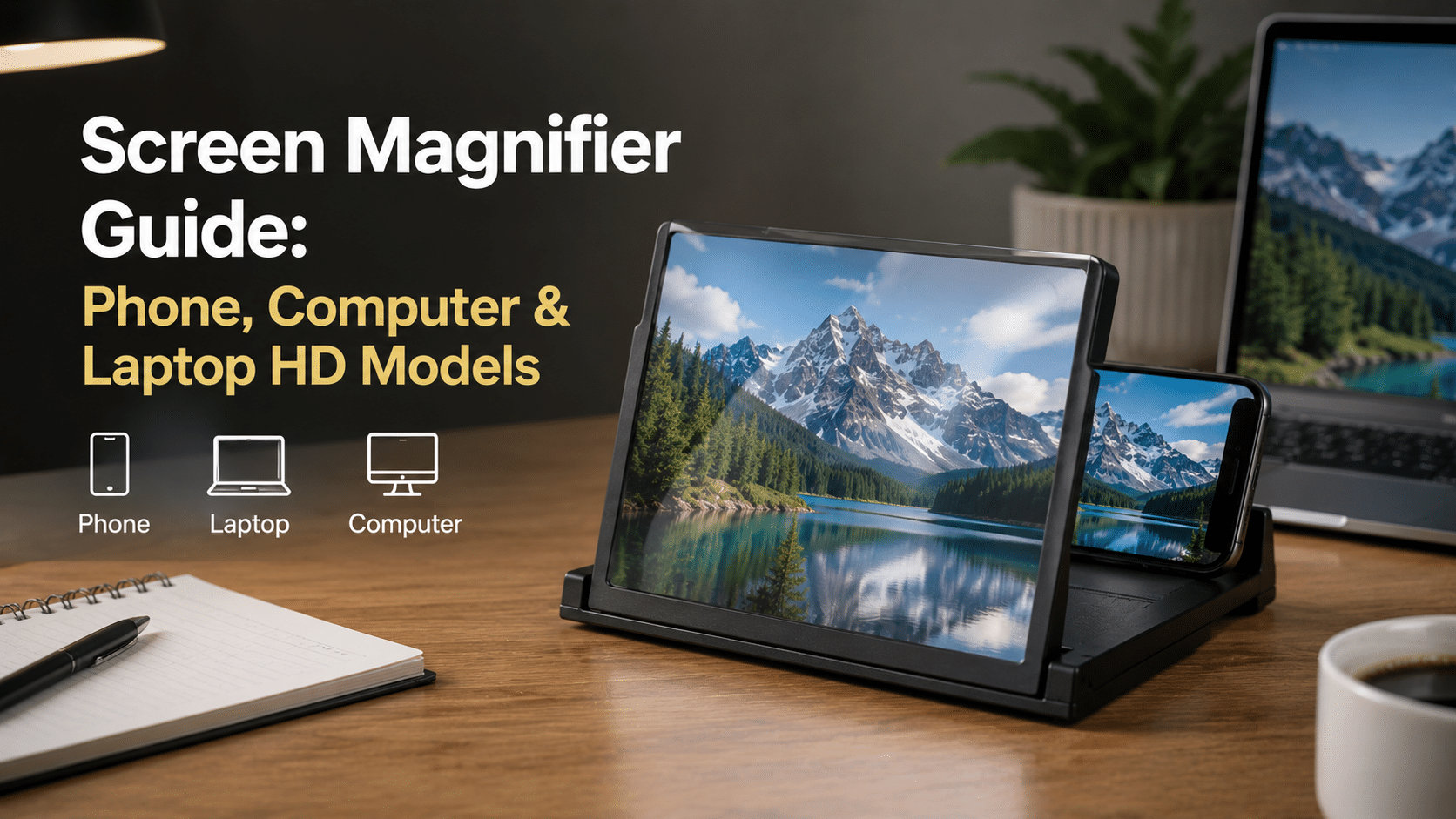
The fresnel lens tv, tv fresnel lens, and fresnel tv lens formats are sold to retailers as flat-screen magnification overlays — the buyer slides a thin acrylic fresnel sheet in front of the TV to enlarge the image for low-vision viewers. Fresnel lens screen magnifiers serve the same role for tablets and laptops.
Projectors & VR Headsets
The fresnel lens projector and fresnel lens vr markets have grown rapidly with the rise of consumer VR. Vr fresnel lens, fresnel vr, and fresnel lens for vr formats are designed to project a focused image onto the user’s eye while keeping the headset weight low. Tight groove pitch and high-clarity acrylic are essential here.
Solar Concentration & Off-Grid Power
Fresnel lenses are widely used in solar concentration. Fresnel lens solar, fresnel solar lens, fresnel lens solar power, fresnel lens solar panel, and fresnel solar panel projects use large fresnel sheets to concentrate sunlight onto a photovoltaic cell or thermal absorber. Coarse-pitch designs are typical because optical resolution does not matter — only total light collection.
PIR Sensors & Motion Detection
The pir sensor fresnel lens is the small white-domed lens that sits in front of motion-detection sensors in alarms, lighting controls, and HVAC systems. The fresnel design allows a single sensor element to “see” multiple zones across a room.
Reading Aids & Low-Vision Magnifiers
Reading-aid retailers stock our fresnel lens magnifier, fresnel magnifying glass, fresnel magnifying lens, fresnel lens magnification, and fresnel lens magnifying glass formats across handheld, page, and bookmark sizes. See our fresnel sheets category, the page magnifier category, and the magnifying sheet category for the full range.
Choosing the Right Fresnel Lens
For wholesale buyers, four specifications matter most:
- Application class — imaging (sharp magnification) or non-imaging (light collection only). This drives material and groove pitch decisions.
- Material — plastic fresnel lens for volume retail, acrylic fresnel lens for imaging, glass fresnel lens for high-temperature or industrial use.
- Format and size — pocket card, A4 sheet, custom-cut, or rigid frame. Custom outlines and printed surrounds add tooling cost but enable branded retail packaging.
- Optical power — typical retail powers run 2X for full-page sheets, 3X for credit-card formats, and up to 4X for premium handhelds. VR and projector applications use bespoke focal lengths.
Wholesale & OEM Fresnel Lens Sourcing
For B2B buyers, the cost economics of fresnel lens production strongly favour ordering directly from a moulding factory rather than going through a distributor. Tooling can be amortised across multiple products that share press lines, and minimum orders for custom outlines typically start at 1,000 units for printed PVC sheets and 2,000 units for tooled acrylic formats. We supply CE / RoHS documentation on every shipment and can produce tooling files from your CAD specifications, your competitor’s reverse-engineered specs, or our own off-the-shelf range.
Common buyer profiles include AV and projector manufacturers ordering acrylic fresnel optics, low-vision retail chains ordering full-page reading sheets, solar-DIY brands ordering large concentrator sheets, education distributors ordering classroom-format kits, and PIR-sensor OEMs ordering injection-moulded dome optics. Read our factory-direct sourcing guide and the manufacturer verification guide before placing your first order.
Quality Specifications & Inspection Standards
Wholesale buyers should specify three measurable quality standards on every fresnel lens order to avoid surprises during incoming inspection:
- Optical clarity — total light transmission should exceed 88% for premium acrylic and 80% for PVC formats. Sub-standard mouldings show milky haze that drops transmission below 75%.
- Groove fidelity — under a 10X loupe, grooves should appear continuous and parallel with no broken edges, dust inclusions, or weld lines from the moulding press. Imaging-grade optics tolerate no visible defects in the active aperture.
- Surface flatness — full-page acrylic sheets should sit flat on a glass plate with less than 1 mm warp across the diagonal; warped sheets cause double-vision distortion.
For UV-stability-critical applications (outdoor signage magnifiers, solar concentrators, automotive PIR housings), specify UV-stabilised acrylic and ask for accelerated weathering test data. For impact-critical applications (children’s magnifier sheets, point-of-sale magnifiers), specify polycarbonate substrate or impact-modified acrylic. Our fresnel sheets category publishes per-product clarity and impact specifications, and we provide third-party test reports on request for regulated channels.
Frequently Asked Questions
What is a fresnel lens used for?
Fresnel lenses are used to magnify, focus, or collect light wherever a conventional convex lens would be too thick, too heavy, or too expensive. Common uses include reading magnifiers, TV and projector optics, VR headsets, solar concentrators, lighthouses, and PIR motion sensors.
What are fresnel lenses made of?
Most modern fresnel lenses are moulded from acrylic (PMMA) for imaging applications, PVC or PET for thin flexible sheets, or glass for high-temperature industrial use.
Are fresnel lenses better than regular lenses?
For applications that need a flat, lightweight, large-aperture optic, fresnel lenses are dramatically better — they enable shapes and sizes that would be impossible to produce as solid lenses. For applications requiring the highest possible image quality (microscopy, professional photography), conventional aspheric lenses still win because the fresnel grooves introduce minor diffraction artefacts.
What is the difference between an acrylic fresnel lens and a plastic fresnel lens?
Acrylic (PMMA) is a specific clear plastic optimised for optical clarity, scratch resistance, and UV stability — used in TV, VR, and high-end magnifier products. “Plastic fresnel lens” usually refers to lower-cost PVC or PET formats used for flexible sheets, pocket magnifiers, and bookmark optics.
Can fresnel lenses be cut to custom shapes?
Yes. PVC and acrylic fresnel sheets are routinely die-cut into bookmark formats, credit-card outlines, custom-shaped retail blister inserts, and bespoke industrial profiles. Tooling costs vary by complexity.
What MOQ should I expect for wholesale fresnel lens orders?
Standard off-the-shelf products ship from low MOQs. Custom-printed PVC sheets typically start at 1,000 units; tooled acrylic optics and bespoke outlines start at 2,000–5,000 units depending on complexity.
Wholesale Magnifier Sourcing — Talk to Our Team
Eleroyal is a CE, RoHS & ISO 9001-certified manufacturer based in China, supplying retailers, B2B distributors, and brand owners worldwide. We support flexible MOQs, OEM and private-label runs, custom packaging, and full export documentation. Whether you are placing your first order or scaling an existing programme, our sales team can match the right product specifications to your channel — request a wholesale quotation or browse our full magnifier catalogue.
Common buyer profiles we work with include retail chains stocking low-vision and senior-care programmes, optical and pharmacy distributors, jewellery and gift-shop chains, AV and cinema-supply wholesalers, education and STEM-curriculum distributors, electronics-repair and maker-space supply houses, and Amazon FBA and ecommerce sellers building branded product programmes. We provide sample units against deposit, and our minimum-order specifications scale across product format, custom branding complexity, and lead-time tolerance — so first-time buyers can validate the product on their channel before committing to a full retail launch.