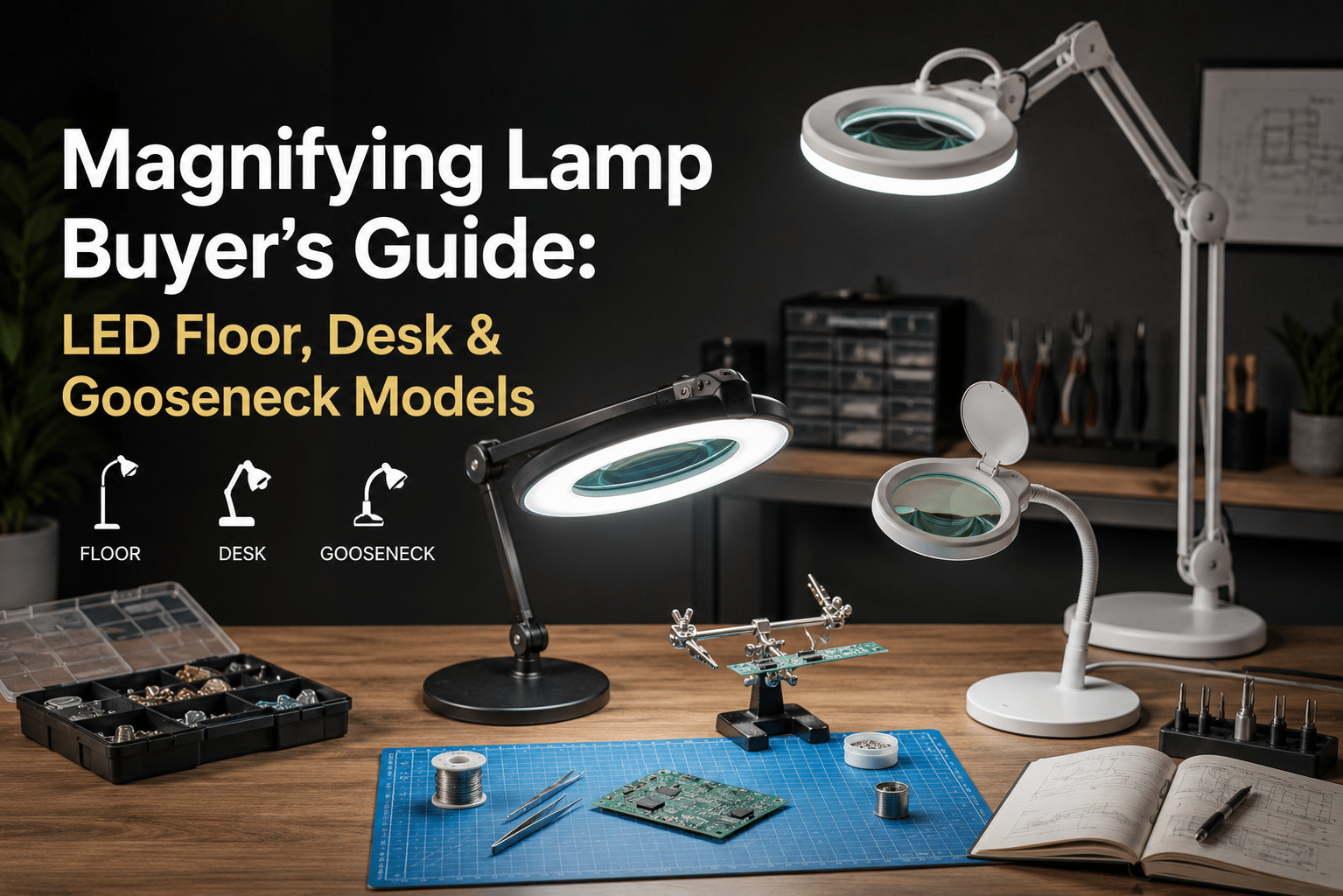







In every factory, warehouse, laboratory, and workshop around the world, one deceptively simple tool plays a critical role in guaranteeing product quality: the magnifying glass. While modern industry has embraced digital cameras, automated scanners, and computer vision systems, the optical magnifier remains irreplaceable on the production floor. It is fast, reliable, requires zero boot time, and delivers results that any trained inspector can interpret immediately.
At Eleroyal Magnifier, we have spent over 17 years designing and manufacturing precision magnification tools for industrial clients across textiles, electronics, jewelry, printing, pharmaceuticals, and beyond. This guide draws on our deep manufacturing expertise to explain exactly how magnifying glasses are used in industrial quality control — and how to choose the right tool for each application.
1. Why Magnification Matters in Industrial Quality Control
Quality control (QC) is the systematic process of ensuring that products meet defined standards before they reach the customer. In most industries, defects are microscopic — a hairline crack in a circuit trace, an uneven thread count in fabric, a micro-inclusion in a gemstone, or a misaligned hallmark on a piece of jewelry. The naked eye simply cannot detect these issues reliably.
Magnifying glasses close the gap between what inspectors can see and what needs to be seen. They provide an immediate, non-destructive view of fine details, allowing inspectors to:
- Identify surface defects invisible to the naked eye
- Measure dimensions at the micro level using scaled reticles
- Verify print quality, markings, and serial numbers
- Detect material inconsistencies before they reach final assembly
- Authenticate products and detect counterfeits
WHY OPTICAL MAGNIFIERS REMAIN ESSENTIAL
Unlike digital inspection systems that require calibration, software licensing, and downtime for maintenance, a quality magnifying glass is operational in seconds. For high-volume production floors, this speed advantage is significant.
2. The 6 Core Industrial Applications of Magnifying Glasses
2.1 Textile & Fabric Inspection
The textile industry relies on a specialized category of magnifier known as a linen tester or thread counter. These instruments are placed directly on fabric to measure thread density — the number of warp and weft threads per square centimeter or inch.
Thread count directly correlates with fabric quality, durability, and market value. A deviation from specification by even a few threads per centimeter can mean the difference between a premium and a substandard product — a difference that buyers will notice immediately.
Key magnifiers for textile QC include:
- 10X Zinc Alloy Folding Linen Tester Loupe with Measuring Scale — designed to sit flat on fabric for stable, hands-free thread counting
- 30X High Power Linen Tester Loupe with LED + UV Lights — for inspecting weave density at extreme detail with dual illumination
- 10X Handheld Metal Loupe with Scale — for portable quality inspection across textile production lines
2.2 Electronics & PCB Inspection
Printed circuit boards (PCBs) are among the most detail-demanding products in modern manufacturing. Solder joints, component placements, trace widths, and pad alignments all require close-up inspection that magnification tools make possible.
In electronics QC, inspectors use lighted magnifiers and helping-hand stations to examine:
- Solder bridges and cold joints after reflow soldering
- Component orientation and polarity verification
- PCB trace continuity and micro-crack detection
- Connector pin alignment before final assembly
For this application, hands-free magnifiers mounted on articulating arms or soldering stations are especially valuable — they free both hands for simultaneous inspection and repair work.
ELEROYAL PRODUCT HIGHLIGHT
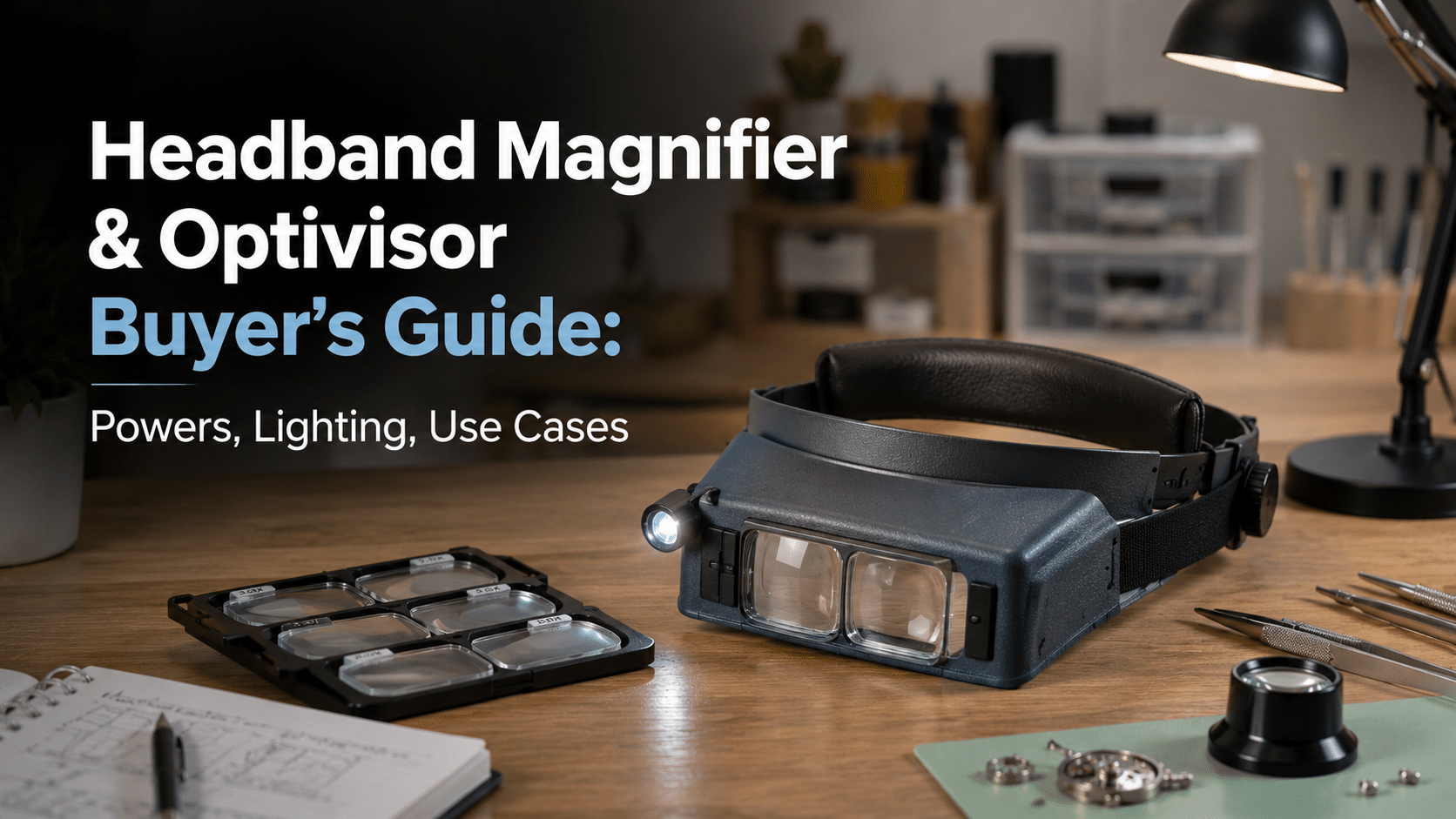
Eleroyal’s Pro LED Lighted Helping Hands Soldering Station offers three magnification levels (3X / 4.5X / 25X), 10 adjustable LEDs, alligator clips, and a soldering iron holder — a complete precision workstation for electronics manufacturing environments.
2.3 Jewelry & Gemstone Appraisal
Perhaps the most well-known professional use of magnifying loupes is in the jewelry trade. Gemologists, appraisers, and manufacturing QC teams use loupes to examine:
- Inclusions, fractures, and clarity characteristics in gemstones
- Fluorescence under UV light to detect treatments
- Metal hallmarks, stamps, and authentication marks
- Prong setting quality and stone security
- Surface finish and polish on precious metals
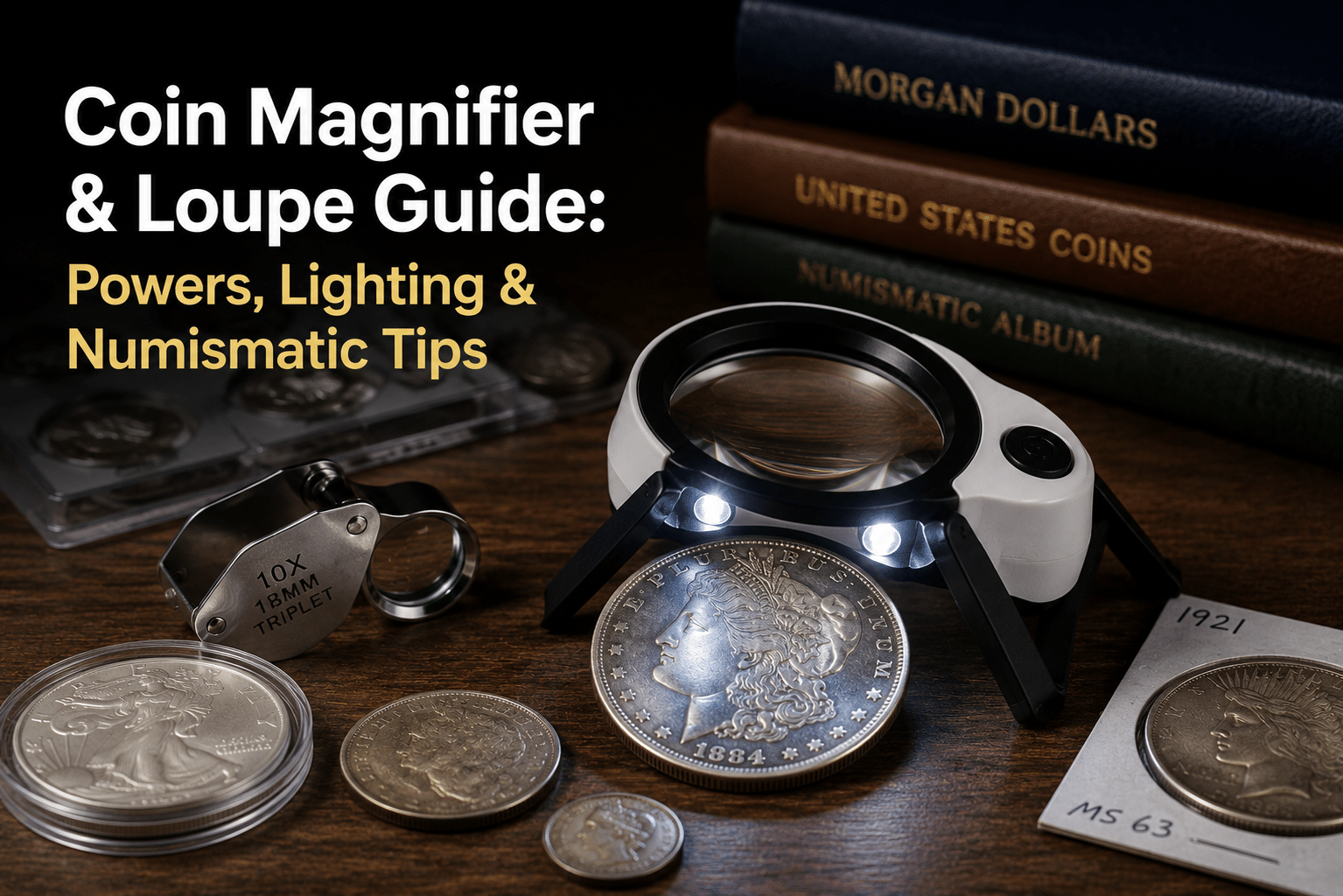
Industry standard calls for a 10X triplet loupe — three optical elements corrected for chromatic and spherical aberration — which has been the jeweler’s tool of choice for decades. More advanced inspection may use 30X, 40X, or even 60X magnification for extreme detail.
2.4 Printing & Packaging Quality Control
In commercial printing, even the smallest misregistration, dot gain variation, or color inconsistency can render an entire print run unusable. Print QC professionals use magnifying loupes to inspect:
- Halftone dot patterns and screen rulings
- Ink trapping and color overlay accuracy
- Barcode and QR code print quality
- Fine print legibility on labels and pharmaceutical packaging
- UV varnish and foil stamp alignment
Handheld loupes with built-in measurement scales (reticles) are particularly valuable here, allowing inspectors to precisely measure dot sizes and registration marks without removing the material from the production line.
2.5 Pharmaceutical & Medical Device Inspection
Regulatory standards in pharmaceuticals and medical devices are among the strictest in any industry. Visual inspection is a mandated part of QC processes under standards including ISO 13485 and GMP guidelines. Magnifying glasses are used to inspect:
- Tablet coatings for cracks, chips, and surface irregularities
- Label print quality and legibility on small packaging
- Seal integrity on blister packs and sterile packaging
- Component markings on medical devices and implants
- Filter integrity and particulate contamination in liquids
2.6 Currency Authentication & Document Verification
UV-equipped magnifiers are extensively used in banking, retail, and border control for counterfeit detection. Legitimate banknotes contain a range of security features — UV-reactive inks, microprinting, security threads, and watermarks — that are invisible without the right tools.
Magnifiers combining white LED illumination and UV light allow inspectors to examine multiple security features in a single tool, making them essential for point-of-transaction authentication.
3. Choosing the Right Magnifier for Industrial QC
Not all magnifiers are created equal. Selecting the right tool depends on four key variables: magnification power, lens type, illumination, and ergonomics. The table below summarizes the optimal configuration for the most common industrial applications.
| Industry / Application | Recommended Magnification | Key Features Required |
| Textile / Thread Counting | 10X – 30X | Built-in scale, folding stand |
| Electronics / PCB | 3X – 25X | Helping hands, LED illumination |
| Jewelry / Gemstones | 10X – 60X | Triplet lens, UV light, portability |
| Printing / Packaging | 10X – 30X | Scale reticle, high resolution |
| Pharma / Medical | 3X – 10X | Wide field of view, bright LEDs |
| Currency / Documents | 5X – 30X | UV light, LED, compact design |
Understanding Magnification Power
Higher magnification is not always better. As power increases, field of view decreases and the working distance (space between lens and subject) shortens. For most industrial inspection tasks, the optimal balance sits between 10X and 30X — high enough to reveal fine defects, low enough to maintain a usable field of view.
Lens Material: Glass vs. Acrylic
Optical glass lenses offer superior scratch resistance, higher light transmission, and better heat resistance than acrylic alternatives. For heavy industrial environments where lenses are handled frequently, glass is the preferred choice. Acrylic lenses, while lighter and more affordable, are well-suited to lower-intensity inspection tasks and consumer-facing products.
Eleroyal uses K9 optical glass — a premium borosilicate glass with excellent clarity and low dispersion — in our professional and industrial-grade product lines, ensuring consistent, distortion-free results for demanding QC environments.
Illumination: LED, UV, and COB
Modern industrial magnifiers integrate illumination directly into the tool. The three principal technologies are:
- White LED — provides bright, true-colour illumination for surface inspection. Ring-LED configurations eliminate shadows entirely.
- UV (Ultraviolet) Light — reveals fluorescent security features, detects gemstone treatments, and exposes certain material defects not visible under white light.
- COB (Chip-on-Board) LED — delivers broader, more uniform illumination than traditional LED arrays, particularly valuable for reading aids and low-vision applications.
4. Eleroyal’s Industrial-Grade Magnifier Range
As a direct-from-factory manufacturer with ISO 9001, CE, RoHS, and EN71 certifications, Eleroyal Magnifier supplies B2B customers — importers, wholesalers, and e-commerce sellers — with industrial-grade optical tools engineered to perform under demanding professional conditions.
Our industrial product range includes:
| Product Category | Best-Suited Industries |
| Loupe & Linen Tester | Textile, printing, philately, gemology |
| Illuminated Handheld Magnifiers | Electronics, pharma, general QC |
| Helping Hand Stations | Electronics assembly, jewelry, soldering |
| Rechargeable Loupes | Fieldwork, gemology, portability-critical roles |
| Desktop Magnifying Lamps | Precision assembly, watchmaking, engraving |
| UV + LED Combination Tools | Currency auth, gemstone appraisal, QC labs |
All Eleroyal products undergo an 8-stage end-to-end production process — from precision mold manufacturing through injection molding, surface hardening, multi-point quality inspection, final assembly, and testing — before leaving our factory in Jiangbei District, Ningbo.
5. OEM / ODM Capabilities for Industrial Buyers
For industrial clients and brand owners who require customised magnification solutions, Eleroyal offers comprehensive OEM and ODM services with flexible minimum order quantities (MOQs).
Our customisation options include:
- Custom magnification configurations tailored to your industry-specific inspection requirements
- Branded packaging and logo printing for retail or private-label distribution
- Custom lens shapes, sizes, and optical specifications
- Specialised illumination configurations (LED colour temperature, UV wavelength)
- Exclusive colourways and handle materials for branded product lines
With over 6 new models released each year and a dedicated R&D team continuously developing next-generation optical solutions, Eleroyal is positioned to serve both standard procurement needs and highly specialised custom manufacturing requirements.
OUR COMMITMENT TO INDUSTRIAL BUYERS
Every Eleroyal product comes with a 12-month warranty and unconditional replacement for defective units. Our team guarantees a response to all enquiries within 24 hours.
Precision Starts with the Right Tool
A magnifying glass is far more than a simple optical instrument. In the context of industrial quality control, it is a frontline defence against defects, a bridge between what the human eye can see and what production standards demand, and an essential tool in the daily workflow of inspectors across dozens of industries.
Choosing the right magnifier — with the correct power, lens quality, illumination, and ergonomics — directly impacts the accuracy and efficiency of your QC process. Substandard tools lead to missed defects, customer returns, and reputational damage. Professional-grade optical tools from a proven manufacturer are, by contrast, an investment in the quality of everything your factory produces.
Eleroyal Magnifier has been that manufacturer for 17+ years. We supply industrial buyers, importers, wholesalers, and e-commerce sellers with CE and ISO 9001 certified magnification solutions, backed by factory-direct pricing, flexible MOQs, and dedicated after-sales support.
Ready to source precision magnification tools for your industry? Contact the Eleroyal team at [email protected] or visit contact page to request a product catalogue or OEM quote.